Not how cold
it is.
How long
it stays safe.
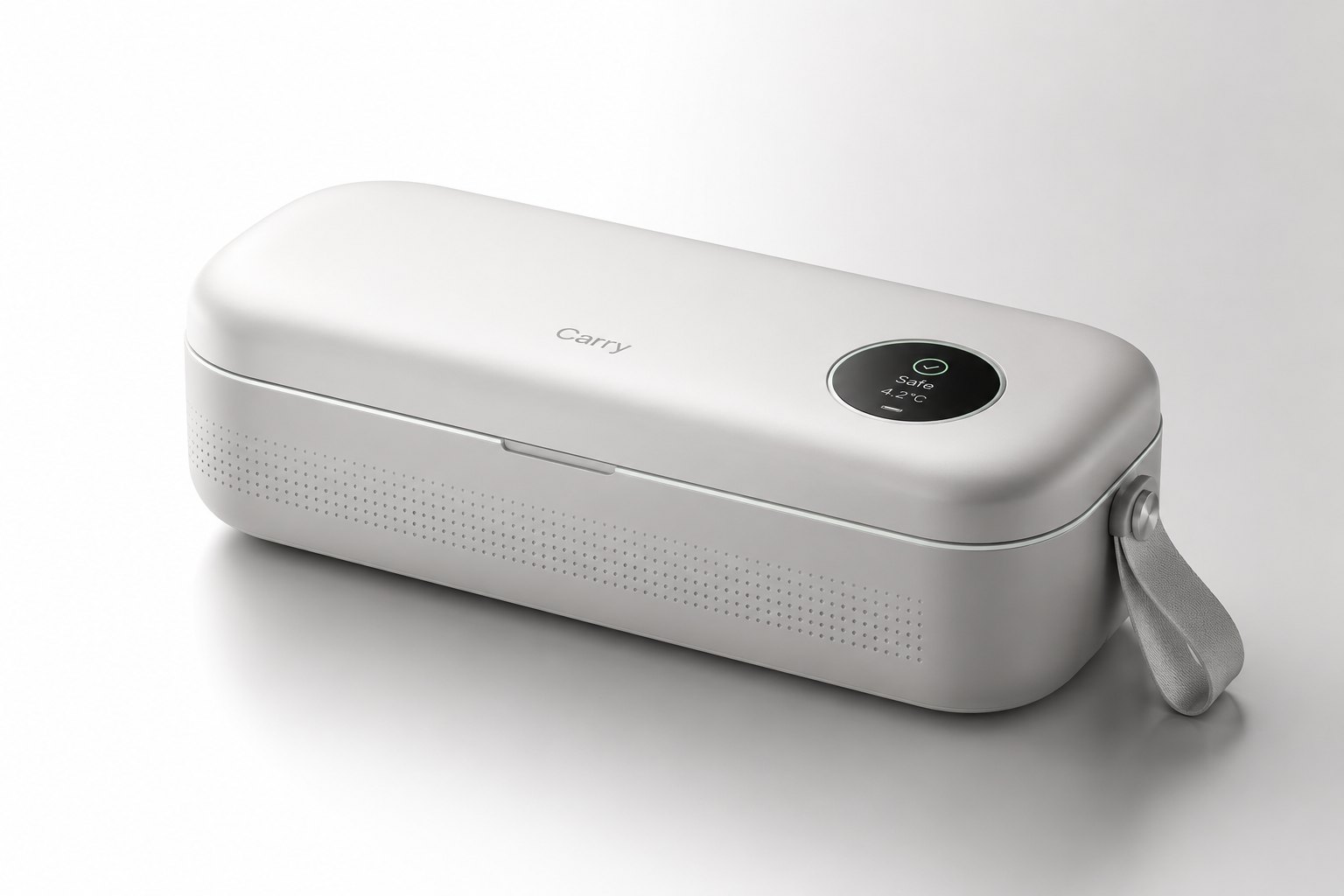
Carry is a portable case for insulin, biologics, fertility treatments and vaccines. A vacuum shell and a phase-change buffer do the protecting. A thermal model does the answering — it reads the case as a physical system and returns the one number a patient needs: how long this dose has left. Modelled to hold a full travel day at room temperature.
Recorded from
conversation, 2025.
The problem was
never the cooling.
It was never knowing
whether the cooling
had been enough.
My mother has lived with chronic migraines for as long as I can remember. When refrigerated biologic injections finally gave her relief, they arrived with a quiet new worry attached.
Every flight, every heatwave, every power cut raised the same question, and nothing she owned could answer it: had the medicine stayed cold enough to still work?
I watched her open a cooler bag and guess. Carry began as an attempt to replace that guess with a number — for her, and for the millions of people carrying insulin, biologics and vaccines with exactly the same uncertainty.
A case you'd actually carry every day
Cold-chain equipment tends to look like laboratory hardware, so people leave it at home on the day it matters. Carry is sized to a coat pocket or a handbag: a single sealed volume, one glanceable readout, no app required to answer the question.
Holds the cold
A vacuum-insulated shell slows heat transfer far more effectively than the foam in a cooler bag, so the wall can be thin enough to carry. Inside, a phase-change material tuned near the 2–8 °C storage range absorbs incoming heat as it melts, holding the interior almost flat for hours.
Explains the cold
Internal sensors log temperature continuously. Because the case's insulation profile is known, that log is enough to run the physics forward: how fast heat is currently arriving, how much of the buffer is left, and therefore how long until the limit is reached.
Ten parts, one sealed thermal volume
The stack is arranged so that everything electrical sits outside the insulated envelope. Sensors reach in; heat sources stay out.
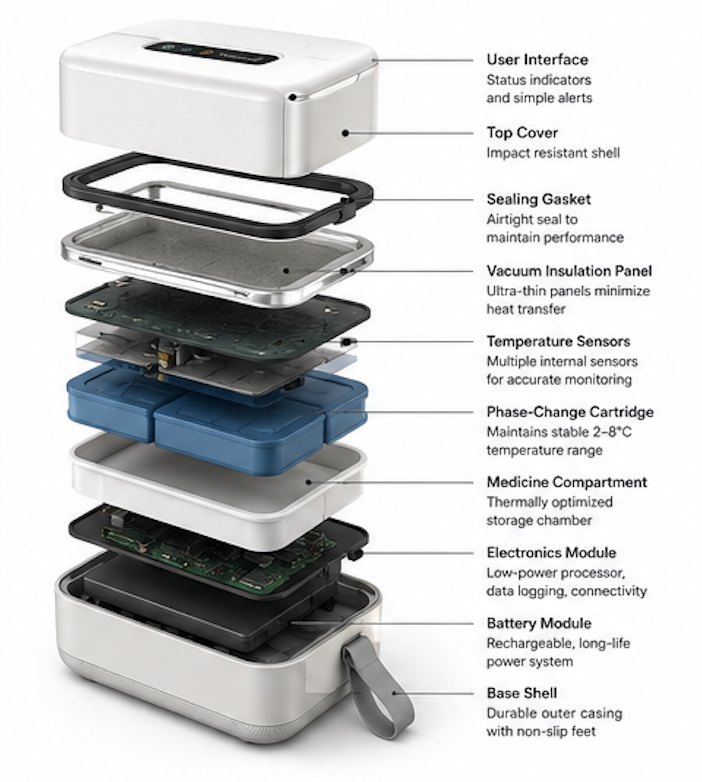
Vacuum panel and gasket define the boundary. The panel does the thermal work; the compression gasket makes sure it is a boundary rather than a suggestion. Any leak path here undoes the panel entirely.
The phase-change cartridge is the battery of the cold. Sized in latent heat rather than volume: roughly 100 g of medium storing about 20 kJ, which is what converts a steep curve into a flat plateau. The intent is for it to be user-replaceable so the case outlives the chemistry — the removal mechanism is not yet resolved.
Multiple probes, not one. A single sensor reports where it happens to be. Several report a gradient, which is what the model needs to tell a warm lid from a warm dose.
Electronics and battery must sit outside the cold volume. Their waste heat should never become the load the buffer has to fight. The current assembly shows a single vacuum panel above the compartment, so a second boundary between the compartment and the electronics module is an unresolved requirement, not a solved one.
An alarm that arrives too late is just a receipt
Cold-chain products split into two groups, and neither answers the patient's question. Passive cases like Frio monitor nothing at all. Bluetooth loggers like MedAngel and Berlinger monitor accurately, but report a breach that has already happened. For a product whose room-temperature allowance can be spent but not recovered, that is not a warning. It is a receipt.
Reactive — a temperature logger
Reads the sensor, compares it against a threshold, and alerts the moment the threshold is crossed. Accurate, and useless at the only moment that counted — by the time it fires, the dose is already outside its label and the allowance is already spent.
Predictive — Carry
Treats the case as a thermal system with a known insulation profile and a known amount of buffer left, then projects forward to the crossing point. The warning arrives with time still attached, while moving to a fridge is still an option.
Damage accumulates. So the count shouldn't reset
This is where the two product classes diverge. Vaccines are governed by cumulative time out of refrigeration. Biologics are typically labelled as a single room-temperature allowance — often fourteen days at or below 25 °C, once, with no return to the fridge afterwards. Both are lifetime budgets. A device that starts from zero every morning is measuring the wrong thing.
Carry keeps a running total against the specific product's published stability window and carries it forward with the medicine, not the trip. Someone who has already spent a third of a fourteen-day allowance on a failed delivery and a warm hotel room can see that before booking a holiday — instead of discovering it through a dose that quietly stopped working.
It also changes what a warning means. Near the start of an allowance, a short excursion is a note. Near the end, the same excursion is the reason to call a pharmacist.
A spoiled dose is a dose manufactured twice
I spent three years as a data analyst in renewable energy, where most of the job was separating energy claims that survive arithmetic from claims that don't. So this sheet is a calculation, not a badge. The environmental case for Carry is not the materials it is made from — it is that refrigerated medicine carries an unusually heavy footprint before it reaches anyone, and a dose thrown away has to be manufactured, chilled and flown a second time.
What the case costs to build
Vacuum-insulated panels, a lithium cell, a small PCB and a phase-change cartridge. None of that is free. A device that adds electronics to a problem previously solved by a foam bag has to justify the electronics, and the honest position is that most consumer hardware marketed as sustainable never runs this calculation at all.
What one prevented dose saves
The full footprint of a biologic that would otherwise be remanufactured, refrigerated through a second cold chain and, for time-critical products, air-freighted again. In mRNA vaccine studies, transport alone accounts for the overwhelming majority of a dose's carbon footprint — so the saving from not repeating the journey is the dominant term.
The figure that decides whether this device is worth building is the payback point: the number of prevented doses at which Carry has repaid its own manufacture. I know the method — embodied carbon of the bill of materials over the avoided footprint per prevented dose — and I know precisely the two inputs still missing: a settled BOM and a measured prevention rate from the pilot on Sheet 09. Publishing an estimate before either exists would be exactly the kind of claim I spent three years taking apart.
The work behind this entry
Primary research with pharmacists, a competitive teardown of what already exists, a study of pharmaceutical cold-chain standards, a built prototype, a working thermal model and a CAD enclosure. The log below is in order and nothing is skipped, including the part that failed — because knowing which assumption broke is the reason the rest of it is trustworthy.
I sat with pharmacists before drawing anything, and asked how patients actually lose refrigerated medicine. The answers were mundane and repeated: deliveries left in a hot van, cooler bags that run out of ice halfway through a holiday, fridges that fail overnight while everyone is asleep. That is where the brief came from — a named failure mode, not an assumed one.
I studied how pharmaceutical shipping already protects these products — vacuum-insulated panels, phase-change cartridges, validated shipper qualification — and set the performance target from that, not from what would sound impressive. I also mapped the competitive field directly: passive cases, Bluetooth loggers, and what neither of them answers.
I hand-built an insulated box to test the geometry, and it returned the single most useful finding in the project: true vacuum insulation cannot be achieved outside a manufacturing environment, which means the panel is a supplier decision rather than a workshop one. It also set the rule the rest of this entry follows — no hold-time claim without measurement.
The projection you can drag on Sheet 01 is mine: a latent-heat plateau followed by a Newtonian approach to ambient, resolving to a coherent physical device at R ≈ 40 K/W with ~100 g of phase-change medium. It runs live in the browser so it can be interrogated rather than asserted. It has not yet been validated against logged data from a physical case, and that is the one claim on this site still waiting on evidence.
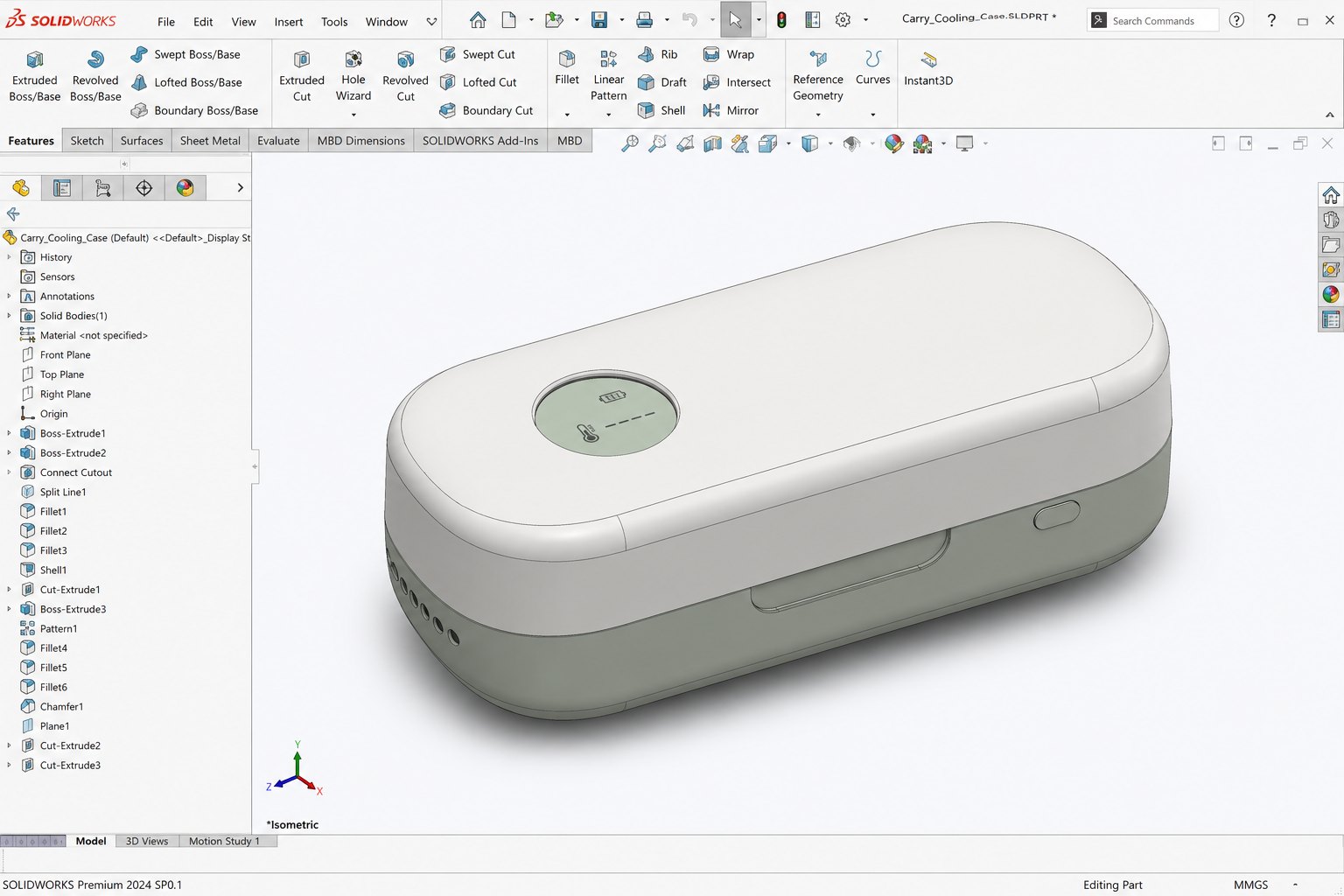
Chamber-testing a built case across a range of ambient conditions, fitting the model to the resulting logs, then a working sensor prototype with a display that answers without a phone nearby. This is the stage where engineering support changes the outcome, and it is the reason for this entry.
Someone already pays for every spoiled dose
A device that only works if patients buy it at full price reaches the people who can afford it, not the people who need it. There is a better-aligned buyer: pharmaceutical patient support programmes already absorb the cost of replacing medication that has been wasted, and a prevented replacement is worth more to them than the case costs.
Put built cases with a diabetes or biologics patient group under genuine travel conditions — hot cars, long-haul flights, winter journeys — and log against the model rather than against a lab bench. The pilot's real output is the fitted model, not a testimonial.
Approach pharmaceutical patient support programmes, which already fund replacement of wasted medication and have a direct line to the exact patients who need this. Their incentive and the patient's incentive point the same direction, which is rare.
The target is a case a patient never has to think about the cost of, because the programme underwrites it. A device priced as consumer hardware protects the wrong people. Unit economics have to close against the cost of one replaced biologic dose, not against a cooler bag.
Why I'm the one building this
Three years as a data analyst in renewable energy taught me how to tell an energy claim that survives arithmetic from one that doesn't. A decade of watching someone I love manage a chronic condition taught me which problem was worth the arithmetic.
Carry is where those two things meet. The modelling, the research, the prototype and the CAD on this page are mine, and so is the decision about which questions are still open.
That's the part I think is worth defending. Carry isn't trying to invent better insulation — the cold-chain industry already has excellent insulation. It's trying to move one number out of a logistics dashboard and into a patient's hand, because the person carrying the medicine is the only one who can still act on it.
Everything unbuilt here is labelled. That isn't modesty — it is the reason the built parts are worth trusting, and it is how I would expect an engineer to read this page.
What I'm looking for
Thermal test facilities, help fitting the model to real logged data, and anyone who has manufactured vacuum-insulated panels at small scale.